CUDA by Example
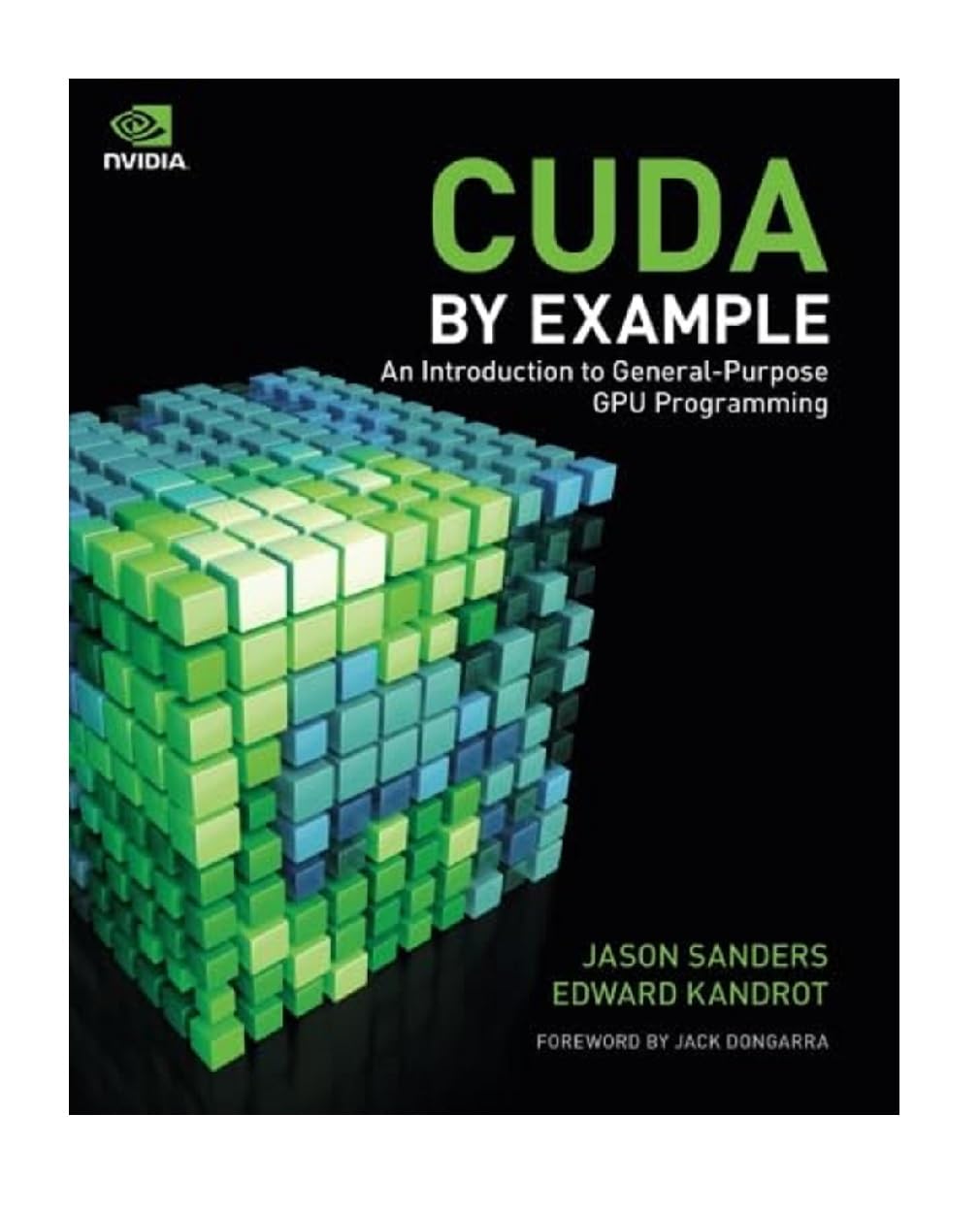
CUDA by Example: An Introduction to General-Purpose GPU Programming, by Jason Sanders and Edward Kandrot (both senior members of NVIDIA’s CUDA team), was published by Addison-Wesley in 2010. It’s one of the gentlest introductions to GPU programming: rather than starting with hardware theory, it teaches CUDA C through small, complete programs you can run and modify.
What it covers
- Foundations: why GPUs became general-purpose processors, setting up a CUDA environment, and the basics of CUDA C: kernels,
__global__functions, device memory, and launching work from the host. - Parallelism: threads, blocks and grids; how to map a problem onto thousands of threads; and examples such as vector addition, dot products and Julia-set fractals.
- Thread cooperation: shared memory,
__syncthreads(), and how threads in a block share work. - The GPU memory system: constant memory, texture memory, and using CUDA events to measure performance.
- Advanced topics: graphics interoperability with OpenGL, atomic operations (including a GPU hash table and histogram), streams for overlapping computation with data transfer, zero-copy host memory, and using multiple GPUs.
Why it’s worth reading
Some APIs and hardware details are dated (the book predates Tensor Cores and modern architectures), but the core ideas haven’t changed: grids and blocks, the memory hierarchy, synchronization, atomics and streams. It’s a quick, hands-on first step before moving to a deeper text like Programming Massively Parallel Processors, and a good base for understanding how deep-learning kernels and inference engines use the GPU.